


MARTINA CHILDREN’S HOSPITAL

Weight Management
Our Weight Management clinic has transitioned to providing treatment for children with obesity in teams with doctors and nurses, within the framework of the paediatric outpatient clinic assignment for obesity.
Treatment Method
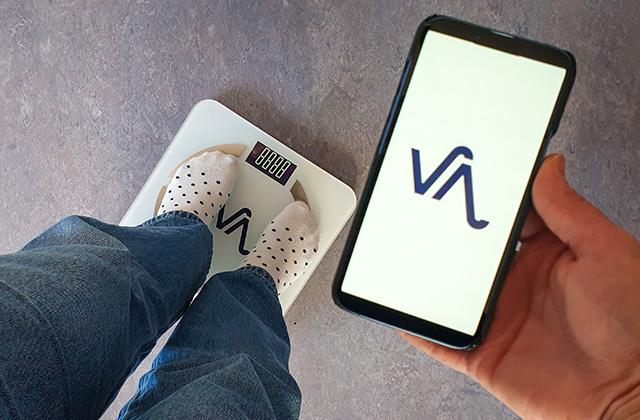
The treatment at Weight Management consists of physical visits every three months combined with digital tools in the form of a special scale (which does not display numbers) that is connected to a mobile app on the phone or tablet. The use of digital tools provides continuous feedback regarding the development of the degree of obesity/overweight and is followed by both parents and healthcare providers, which enables improved support for families even between visits to the clinic.
This method has been tested in research contexts with good results. Researchers from Karolinska Institutet have conducted a study on children who received their treatment at Martina Center for Weight management, which was published in the International Journal of Obesity in May 2022.
In the study, they evaluated the use of a mobile app that shows the child’s weight development in real time for children with obesity and found that this resulted in greater weight loss compared to standard care. The fact that both families and healthcare staff can follow the same data enables individualized additional support when needed. After one year, the children in the study had achieved twice the treatment effect compared to traditional treatment.
The study: International Journal of Obesity
Read more: Mobile app effective support for children with obesity | Karolinska Institutet News (ki.se)
Refer to Weight Management
We offer weight health within the framework of the pediatric outpatient clinic assignment for treatment of obesity. We accept children and adolescents with referrals between 3-17 years with obesity or overweight with medical impact or other risk factors. Please attach medical history (including care history and heredity) and growth curves (height/weight and BMI) from child health services and school health services.
Children who also need a physiotherapist and dietitian should also be referred to primary care.
NOTE! We currently have approximately 6 months waiting time for a first visit.
For questions and feedback:
Frequently Asked Questions
We are sometimes asked whether attempts to lose weight (or maintain weight), or even just a conversation about weight control, can trigger an eating disorder. There is no evidence to suggest that adequate childhood obesity treatment leads to eating disorders. However, weight management does not always protect against eating disorders. In fact, there is evidence that being overweight or obese can lead to an eating disorder, such as binge eating.
Having control over how much one eats and being somewhat preoccupied with it in thought can be necessary when trying to lose weight (or maintain weight). We face many situations and choices during the day when we have to decide how much food to put on our plate, whether to eat another portion, what to drink with the meal, whether we have to eat something sweet with our coffee break, have an evening sandwich, and so on. Being able to say no, abstain, or choose differently actually requires us to make conscious choices and think about food and drink in various situations several times a day. This in itself does not mean that it is a bad or disordered behavior.
It is only when the child shows signs of, or talks about, skipping meals, secretly eating, lying, or losing control of how much they eat, feeling guilty after eating, trying to compensate by exercising immediately afterward, or trying to vomit food, that it becomes a problem.
We have all children over the age of nine answer questions about feelings related to eating and eating behavior.
Many parents find it difficult and sensitive to talk to their child who is overweight or obese, even though they understand it is a necessary conversation to have. Perhaps the parents or the child themselves have been alerted by a school nurse that the weight is too high or increasing rapidly, maybe a peer has made an unpleasant comment, or perhaps the child has their own thoughts and concerns about their weight and body.
We all, regardless of age, are influenced by our surroundings and how they view weight. Even though it is becoming more common to see different types of bodies on social media, it is often the normative ‘perfect’ body that we and our children see most frequently and that affects us the most. Those of us who work with overweight and obesity in healthcare always view the body and weight from a health perspective. We know there are many aspects related to the topic; energy levels, pain somewhere in the body, mental health, snoring, appearance, clothing, friendships and romantic relationships, school performance, sedentary lifestyle, fear of illness, and so on. It is important to distinguish between a healthy weight and any values and prejudices surrounding the body and how it has nothing to do with one’s human worth or others’ right to comment on one’s appearance.
If your child is overweight, you can usually assume that the child is aware of it. Despite the feelings it may evoke, such as sadness or anger in the child, it is often a relief when someone acknowledges the problem and opens up about how to work together on it. The approach to a conversation about weight can vary, especially depending on the child’s age. The youngest children rarely need to be aware of changes that need to be made to maintain weight control. If the child brings up the topic themselves, whether it concerns health, relationships, appearance, or something else, it is a good idea to focus on what is important to the child/teenager. However, we should avoid linking a slim body or weight loss to ‘being/becoming beautiful.’
The introduction to a weight conversation with a child or teenager could be: ‘I’ve been thinking about health and how it can be reflected in weight.’ ‘When I see how your weight seems to be increasing faster than your height, I think it could be dangerous for your health in the long run.’ ‘What do you think about that?’ Ask open-ended questions that can make your child reflect for a moment. Even if the answer is a shrug or ‘I don’t know,’ the topic is at least raised and can be revisited at a later time.
We who work at the Weight Management clinic
